Moth Orchid
Phaelenopsis spp.

Plant Overview
The Moth Orchid (Phalaenopsis spp.) is one of the world’s most popular flowering tropical indoor houseplants, admired for its graceful blooms, elegant form, and remarkably long-lasting flowers. Native to the tropical forests of Southeast Asia, southern China, the Philippines, Indonesia, and northern Australia, these orchids grow naturally as epiphytes, anchoring themselves to the branches and trunks of trees rather than rooting in the ground. Suspended within the rainforest canopy, they receive filtered light, warm temperatures, regular rainfall, and constant air movement.
Their natural way of life explains much of what makes them unique. Rather than drawing nutrients from soil, Moth Orchids absorb moisture and dissolved minerals from rain, humid air, and organic matter that collects around their roots. This adaptation allows them to thrive high above the forest floor, where light is plentiful but never harsh.
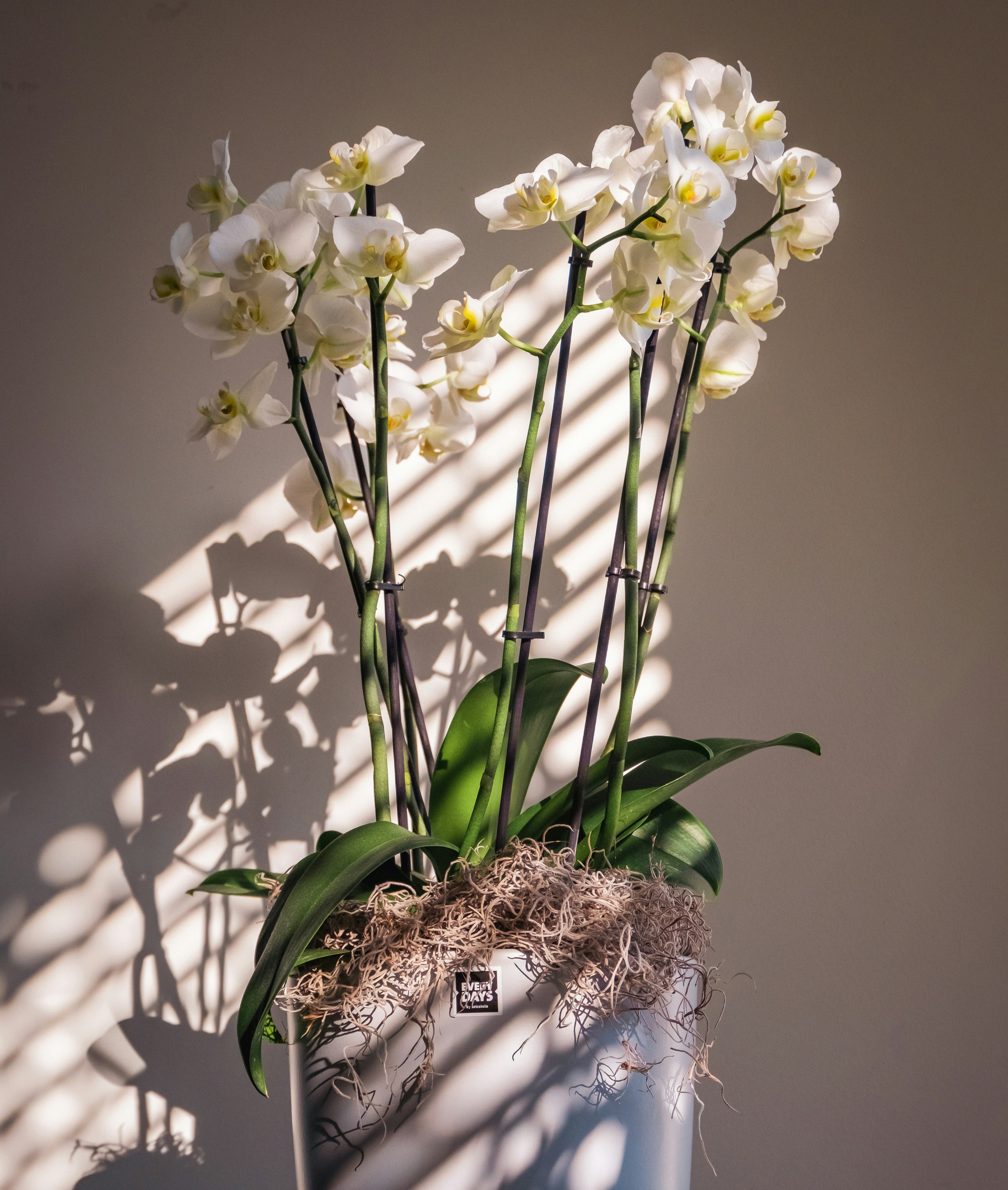
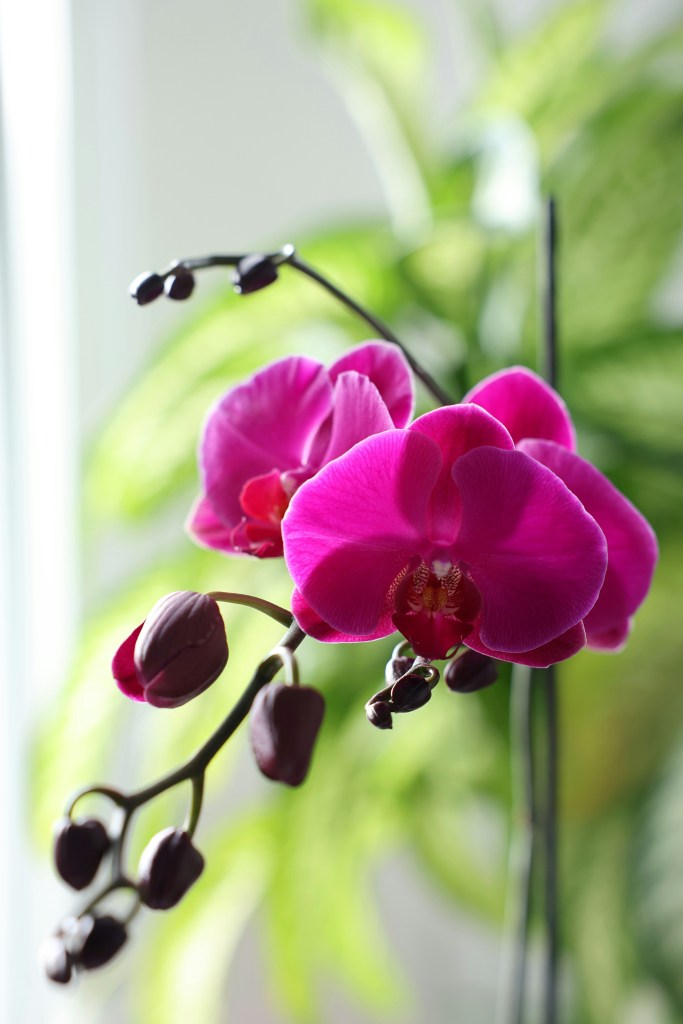
Among flowering houseplants, few possess the quiet elegance of a Moth Orchid. Arching stems carry delicate blooms that seem almost suspended in the air, remaining fresh for weeks or even months. Their flowers are available in an extraordinary range of colours, including pure white, soft pink, vibrant magenta, yellow, peach, and richly patterned combinations that reflect decades of careful breeding.
The beauty of a Moth Orchid is not fleeting. Its flowers remain present long enough to become part of everyday life, inviting repeated observation rather than demanding immediate attention. Over time, the plant reveals that its appeal lies not only in the blooms themselves but also in the patient rhythm with which they appear, fade, and return.
Appearance & Growth Habit
Moth Orchids are compact evergreen perennials that produce broad, fleshy leaves arranged in a neat fan from a central growing point. Mature plants generally reach between 30 and 70 centimetres in height when in flower, making them well suited to tabletops, shelves, and windowsills.
The leaves are thick, smooth, and glossy, serving as water-storage organs that help the plant withstand short periods of dryness. Their deep green colour provides an attractive backdrop for the elegant flower spikes that emerge from the base of the foliage.
Flowering stems arch gracefully, carrying multiple blooms arranged along their length. Individual flowers resemble gently outstretched wings, giving rise to the common name “Moth Orchid.” Depending on the cultivar, blooms may range from 5 to 12 centimetres across and often remain in excellent condition for two to four months.
The roots are equally distinctive. Thick, silvery-green aerial roots grow both within and beyond the pot, covered by a specialised tissue known as velamen that rapidly absorbs moisture. These exposed roots are a normal and healthy feature of the plant, reflecting its epiphytic lifestyle.
Growing Conditions
As a tropical indoor houseplant, Moth Orchid thrives in bright, indirect light similar to the filtered sunlight beneath a rainforest canopy. An east-facing window or a bright room protected from direct afternoon sun generally provides ideal conditions. Too much direct sunlight may scorch the leaves, while insufficient light often reduces flowering.
Unlike most houseplants, Moth Orchids are grown in a specialised orchid bark mix rather than traditional potting soil. Coarse bark, charcoal, and other free-draining materials allow air to circulate around the roots while preventing excessive moisture retention.
Warm temperatures between 18°C and 28°C are ideal throughout the year. Moderate to high humidity encourages healthy growth, although the plant adapts well to typical indoor conditions provided there is reasonable air movement.
Transparent orchid pots are often beneficial because they allow light to reach the photosynthetic roots while making it easier to monitor moisture levels within the growing medium.
Care & Maintenance
Moth Orchids reward consistent, gentle care. Water thoroughly when the orchid bark approaches dryness, allowing excess water to drain completely before returning the plant to its decorative container. Standing water around the roots should always be avoided.
The crown of the plant should remain free from water, as moisture trapped between the leaves may lead to crown rot. Watering in the morning allows any remaining moisture to evaporate during the day.
During spring and summer, applying a balanced orchid fertiliser at half strength every two to four weeks supports healthy growth and future flowering. Feeding can be reduced during autumn and winter as development naturally slows.
Once flowering has finished, the flower spike may be trimmed according to its condition. Green spikes sometimes produce additional flowers from dormant buds, while brown or dried stems are best removed near the base.
Repotting every two or three years into fresh orchid bark helps maintain healthy roots as the growing medium gradually decomposes. Healthy roots appear firm and green or silvery, reflecting the plant’s overall condition.
Seasonal Notes
Although grown indoors, Moth Orchids continue to respond to seasonal changes in temperature and daylight.
Spring often brings fresh leaf growth and the development of new roots, signalling the beginning of another growing cycle. Healthy plants gradually build the energy required for future flowering.
Summer is a period of steady vegetative growth. Warm temperatures encourage the production of leaves and roots while the plant quietly prepares for the coming flowering season.
Autumn often provides the gentle temperature difference between day and night that encourages the formation of flower spikes. Watching a slender stem emerge from the base of the leaves brings quiet anticipation, as each stage of its development unfolds over several weeks.
Winter is frequently the season of greatest floral display. Long-lasting blooms brighten indoor spaces during the darker months, offering colour and elegance when many outdoor plants lie dormant. Even after flowering concludes, the glossy foliage remains attractive, carrying the promise of another flowering season in the years ahead.
Uses
Moth Orchids are among the finest tropical indoor houseplants for adding elegance to homes, offices, hotels, reception areas, and other interior spaces. Their compact size and exceptionally long flowering period make them ideal for dining tables, coffee tables, bedside cabinets, desks, and bright windowsills where their blooms can be appreciated at close range.
Their refined appearance complements a wide variety of interior styles, from contemporary minimalist homes to traditional spaces filled with natural materials. The arching flower stems introduce movement and softness without overwhelming the room, while the glossy foliage continues to provide year-round interest long after the flowers have faded.
Although Moth Orchids are not generally recognised as significant air-purifying plants in the same way as species such as Peace Lily or Golden Pothos, they contribute to the sense of vitality that living plants bring to indoor environments. Their presence introduces colour, texture, and a gentle reminder of the tropical forests from which they originate.
There is a quiet patience to growing a Moth Orchid. Much of the year passes in simple green growth before a flower spike slowly begins to rise. Weeks later, one bloom opens, then another, until the entire stem is alive with flowers. The display cannot be hurried, yet perhaps that is part of its enduring appeal. Its beauty arrives gradually, inviting us to notice not only the flowers themselves, but the quiet progression that brought them into being.