English Box
Buxus sempervirens

Plant Overview
English Box (Buxus sempervirens) is one of the most enduring and recognisable evergreen shrubs in ornamental horticulture. For centuries it has been used to shape formal gardens, define pathways, frame borders, and create intricate topiary. Native to parts of southern and western Europe, North Africa, and western Asia, it has become closely associated with traditional gardens throughout Britain and Ireland, where its timeless appearance continues to influence garden design.
Its appeal lies not in dramatic flowers or vivid seasonal colour, but in its remarkable consistency. Throughout the year, English Box provides structure when herbaceous borders fade, definition when neighbouring plants spill beyond their boundaries, and a sense of permanence that quietly anchors the garden. It is a plant that asks little attention for itself, yet its absence is immediately noticeable.
Many gardens are remembered for their flowers, but they are held together by their structure. English Box performs this role with quiet confidence. Whether clipped into crisp geometric forms or allowed to soften naturally over time, it provides rhythm and order without diminishing the beauty of the plants around it.
There is a reassuring quality to mature box hedging. Season after season, it remains present, gradually acquiring character with age. In gardens that evolve over decades rather than years, English Box becomes part of the landscape’s memory, marking pathways walked countless times and enclosing spaces that invite people to linger.
Appearance & Growth Habit
English Box is a slow-growing evergreen shrub with a naturally dense, compact habit. Left unpruned, it can eventually reach between 3 and 5 metres in height, although it is far more commonly maintained as a low hedge or carefully shaped specimen. Its slow rate of growth is one of its greatest strengths, allowing it to retain crisp forms with relatively infrequent pruning.
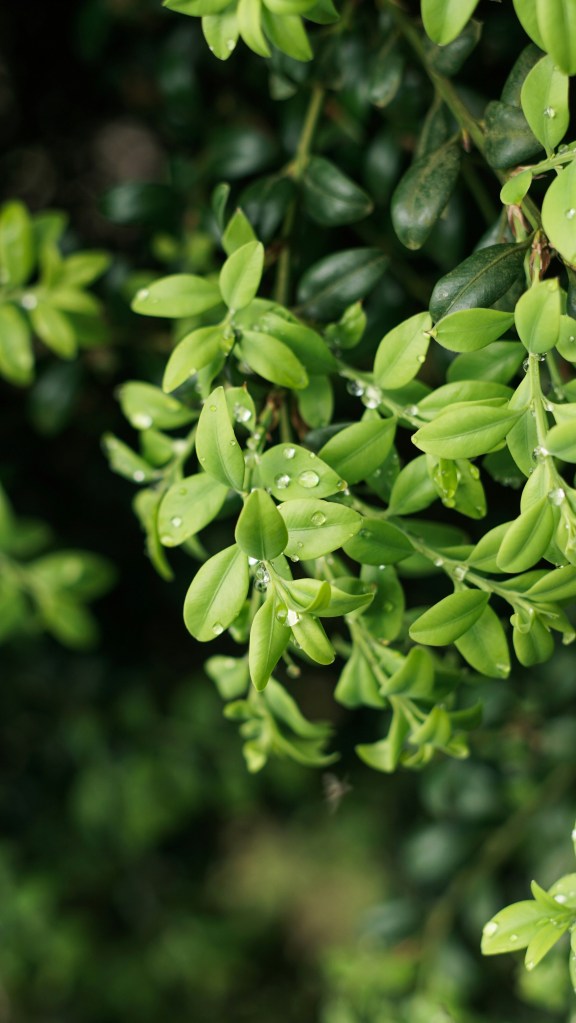
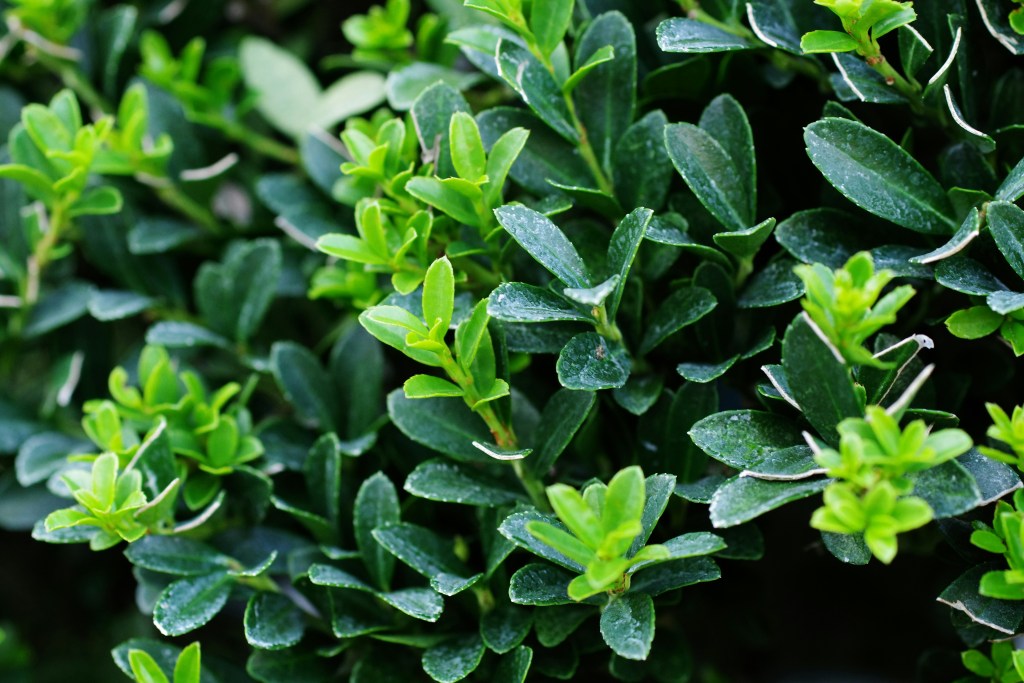
The foliage consists of small, rounded leaves arranged in opposite pairs along finely branched stems. Their rich green colour remains remarkably consistent throughout the year, providing dependable texture in every season. New growth often emerges in a lighter shade before gradually deepening as it matures, creating subtle seasonal variation that rewards close observation.
In spring, inconspicuous pale yellow flowers appear among the foliage. While easily overlooked, they produce nectar that attracts bees and other pollinating insects, offering an early-season food source. The flowers are followed by small seed capsules that are seldom considered a significant ornamental feature.
Perhaps the greatest beauty of English Box lies in its branching structure. Dense, finely divided stems create a naturally uniform surface that responds exceptionally well to clipping. Even when shaped formally, the shrub retains a softness that prevents it from feeling rigid or artificial, allowing it to blend comfortably into both traditional and contemporary landscapes.
Growing Conditions
English Box is adaptable to a wide range of garden conditions and is one of the reasons it has remained popular for generations. It grows well in full sun, partial shade, and even fairly deep shade, although good air circulation is beneficial in all situations.
The plant performs best in fertile, well-drained soils enriched with organic matter. It tolerates loam, chalk, clay, and sandy soils provided drainage is adequate. Prolonged water-logging should be avoided, as excessive soil moisture can weaken the root system and increase susceptibility to disease.
Once established, English Box demonstrates moderate drought tolerance, although prolonged dry periods may affect the appearance of the foliage. Applying organic mulch helps maintain consistent soil moisture while improving soil structure over time.
Sheltered locations are generally preferred, particularly where protection from strong winter winds reduces the risk of foliage scorch. With appropriate placement, English Box can remain healthy and attractive for many decades.
Care & Maintenance
The enduring popularity of English Box owes much to its manageable maintenance requirements. During establishment, regular watering encourages the development of a strong root system. Mature plants require relatively little supplementary watering except during prolonged dry weather.
An annual application of compost or well-rotted organic matter helps maintain soil fertility and moisture while encouraging healthy, steady growth. Additional fertiliser is rarely necessary unless soil conditions are particularly poor.
Pruning is usually carried out once or twice during the growing season, depending on the desired level of formality. Trimming in late spring or early summer encourages dense growth, while a second light trim later in the season can maintain crisp outlines. Using sharp tools helps preserve the clean appearance of the foliage.
As with many long-lived plants, regular observation is often the most valuable aspect of care. In recent years, box blight and the box tree moth have presented significant challenges in some regions. Monitoring plants for early signs of disease or pest activity allows timely management and helps maintain healthy specimens. Good airflow, appropriate spacing, and careful hygiene when pruning all contribute to reducing potential problems.
Seasonal Notes
English Box moves through the seasons with quiet restraint. Spring brings soft new growth that brightens the shrub before gradually maturing to its familiar deep green. The tiny flowers appear almost unnoticed, yet their arrival signals renewed activity within the garden.
Summer highlights the plant’s structural role. As neighbouring perennials flower and expand, English Box provides calm definition, allowing more exuberant plantings to be appreciated without overwhelming the space.
Autumn brings subtle changes in tone rather than dramatic transformation. The foliage remains dependable while fallen leaves from surrounding deciduous trees gather gently along the base of hedges, creating pleasing seasonal contrasts.
Winter is perhaps when English Box becomes most valuable. As herbaceous plants retreat beneath the soil and branches of deciduous trees stand bare, its evergreen form continues to define paths, borders, and garden rooms. Frost settling lightly across clipped surfaces reveals textures that may go unnoticed at other times of the year, reminding us that even familiar plants can appear entirely different under changing light and weather.
Uses
English Box remains one of the finest plants for formal hedging, edging, parterre gardens, knot gardens, and topiary. Its dense growth and slow development allow precise shaping while maintaining a natural elegance that never feels excessive.
It is equally at home in contemporary landscapes, where clipped forms provide architectural contrast to ornamental grasses, perennials, and looser naturalistic planting schemes. Individual specimens can be grown in containers beside entrances or along terraces, introducing year-round structure to outdoor living spaces.
The evergreen foliage offers shelter for small garden creatures, while the spring flowers provide a modest but valuable source of nectar for pollinating insects. Although often regarded primarily as a design element, English Box quietly contributes to the wider life of the garden.
Perhaps its greatest contribution, however, is one of continuity. As seasons change, flowers bloom and fade, and borders evolve from month to month, English Box remains steady. It marks the passing of time without drawing attention to itself. A clipped hedge that has been tended year after year gradually becomes woven into the character of a place, offering the reassuring familiarity that only long-lived plants can provide.