Cyclamen
Cyclamen persicum
Plant Overview
Cyclamen (Cyclamen persicum) is one of the most cherished flowering plants of autumn and winter, bringing colour and elegance to homes and sheltered gardens when many other plants have entered their seasonal rest. Native to the eastern Mediterranean, including parts of Greece, Turkey, Syria, Lebanon, and Israel, it naturally grows in cool, rocky woodlands where winter rains encourage growth and flowering before the heat of summer brings dormancy.
Unlike many flowering houseplants that thrive in warmth, Cyclamen is adapted to cooler conditions. Its natural growing cycle follows the Mediterranean climate, producing leaves and flowers during the cooler months before resting through the dry heat of summer. Understanding this seasonal rhythm is the key to growing the plant successfully.
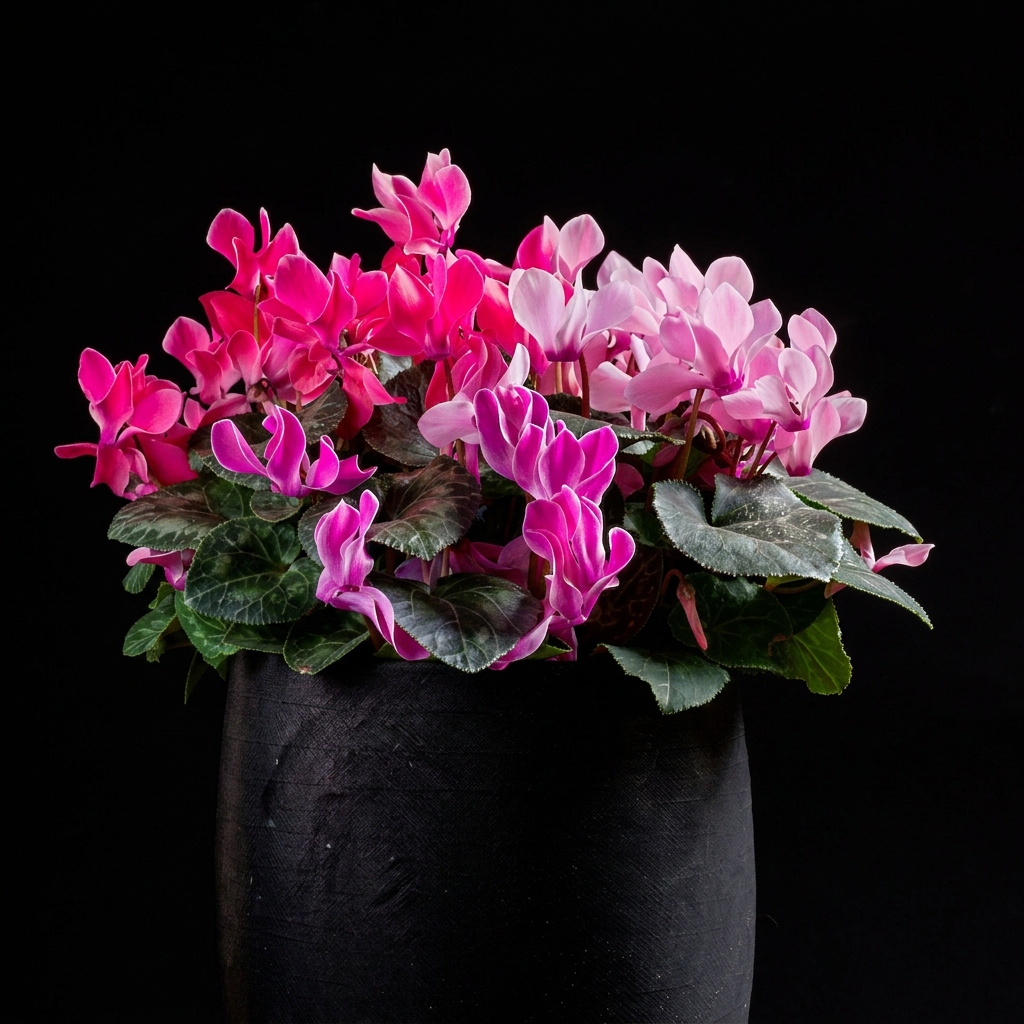
The flowers appear almost to float above the foliage on slender stems, their swept-back petals giving the impression of butterflies hovering above the leaves. Beneath them lies a neat mound of beautifully patterned foliage, often marbled with silver and deep green markings that remains attractive throughout the flowering season.
Cyclamen possesses a gentle elegance. It does not seek attention through large or extravagant flowers, but through balance, refinement, and the welcome brightness it brings to the quieter months of the gardening year. As daylight shortens, its blooms quietly remind us that the garden’s story continues, even in winter.
Appearance & Growth Habit
Cyclamen is a compact perennial that grows from a rounded underground tuber, producing both leaves and flowers directly from its surface. Mature plants generally reach between 15 and 30 centimetres in height, making them well suited to tabletops, windowsills, patios, and sheltered entrances.
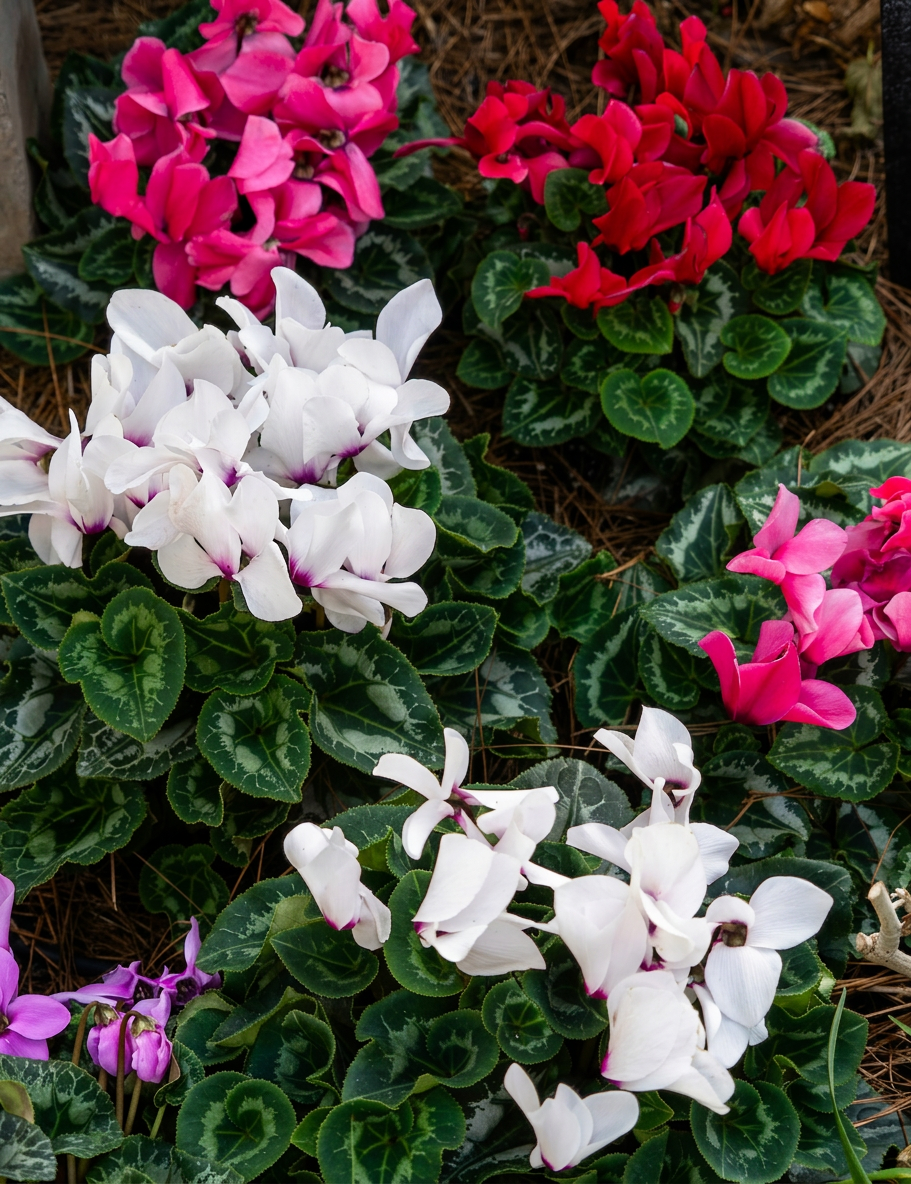
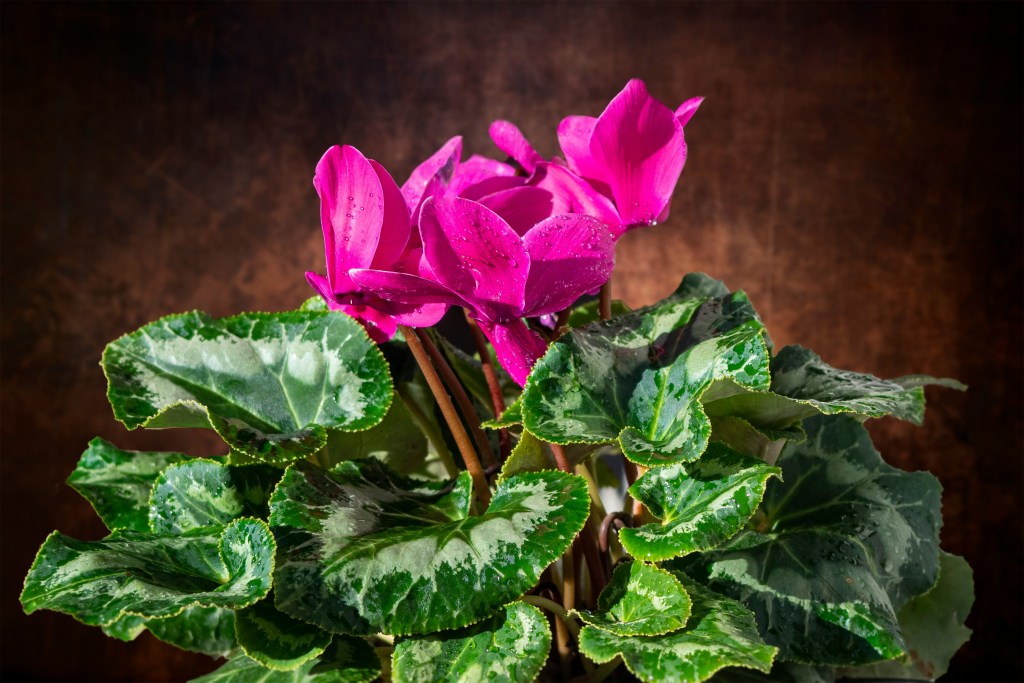
The foliage forms a dense mound of heart-shaped leaves, each displaying intricate silver, grey, and green marbling. Even when the plant is not in flower, the leaves provide considerable ornamental interest and contribute to its distinctive appearance.
Flower stems rise gracefully above the foliage, each carrying a single bloom. The petals curve elegantly upwards, creating the familiar reflexed shape for which Cyclamen is known. Flowers are available in shades of white, blush pink, rose, crimson, magenta, salmon, and deep purple, with many cultivars displaying contrasting eyes or delicately fringed petals.
As flowering progresses, new buds continue to emerge from the centre of the tuber, extending the display over many weeks when conditions remain cool.
Growing Conditions
Cyclamen performs best in bright, indirect light where it receives good natural daylight without prolonged exposure to intense sun. A cool windowsill, enclosed porch, conservatory, or lightly heated room often provides ideal conditions during the flowering season.
Unlike many tropical indoor plants, Cyclamen prefers cooler temperatures between 10°C and 18°C. Excessive warmth, particularly from central heating or fireplaces, often shortens the flowering period and may encourage premature dormancy.
The plant grows best in a free-draining potting mix that remains lightly moist but never saturated. The upper surface of the tuber should sit slightly above the compost to reduce the risk of rot.
In mild climates, Cyclamen often benefits from spending nights outdoors in a sheltered position during autumn and winter, particularly when homes are heavily heated. The cooler night temperatures more closely resemble its natural environment and help prolong flowering. Care should always be taken to protect the plant from frost or prolonged freezing conditions.
Care & Maintenance
Cyclamen rewards gentle, consistent care. Watering should be carried out whenever the surface of the growing medium begins to dry, allowing excess moisture to drain away completely. Water is best applied around the edge of the pot or from below, avoiding the centre of the tuber where excessive moisture may encourage rot.
During active growth and flowering, a balanced liquid fertiliser applied every two to four weeks supports healthy foliage and continuous bloom. Feeding should cease once the plant begins entering dormancy.
Spent flowers are best removed by gently twisting and pulling the entire stem from the tuber rather than cutting it. This helps keep the plant tidy while encouraging additional flower production. Yellowing leaves should be removed in the same manner.
Following the flowering season, the plant naturally enters dormancy. Watering should be reduced as the foliage dies back, allowing the tuber to rest through the warmer months. Fresh leaves will usually begin emerging again as temperatures cool towards autumn.
Cyclamen are generally healthy plants when kept cool and well ventilated. Most problems arise from excessive warmth, poor drainage, or overwatering rather than a lack of care.
Seasonal Notes
Few plants reflect the changing seasons as clearly as Cyclamen.
Autumn marks the beginning of renewed life as fresh leaves emerge from the resting tuber. Soon afterwards, flower buds appear, gradually lifting above the foliage as temperatures continue to cool.
Winter is the plant’s finest season. A succession of elegant flowers provides colour during the shortest days of the year, while the patterned foliage creates interest between blooms. The cool air allows flowers to remain fresh for many weeks.
Spring gradually signals the end of the flowering period. As temperatures begin to rise, flowering slows and the foliage eventually starts to yellow as the plant prepares for dormancy.
Summer is a season of rest. Although little remains visible above the soil, the tuber quietly conserves energy beneath the surface, waiting for cooler conditions before beginning the cycle once more.
Uses
Cyclamen is ideally suited to bright indoor spaces during autumn and winter, where its elegant flowers bring lasting colour to windowsills, dining tables, entrance halls, and conservatories. Its compact size allows it to fit comfortably into smaller spaces while providing a vibrant seasonal display.
In regions with mild winters, Cyclamen also performs beautifully in sheltered courtyards, covered patios, balconies, and outdoor containers. Moving the plant between indoor enjoyment during the day and cooler outdoor conditions at night can often help extend its flowering period when homes are centrally heated, provided temperatures remain above freezing.
The refined flowers pair naturally with simple ceramic pots, timber furniture, and other seasonal plants, creating displays that feel both colourful and understated. Their long flowering season makes them particularly valuable at a time of year when many gardens have become quieter.
Perhaps one of Cyclamen’s greatest qualities is the way it follows its own seasonal rhythm. While much of the garden prepares for winter rest, it quietly begins to flourish. Its flowers appear when the days are shortest, and its summer dormancy reminds us that rest is not the absence of life, but an essential part of its continuing cycle.